Tuesday, November 9, 2010

Fix it or Kick It and the ten minute maxim

One of the things I brought up in my presentation to the Atlanta DevOps group was the concept of "Payment". One of the arguments that people like to trot out when you suggest an operational shift is that "We can't afford to change right now". My argument is that you CAN'T afford to change. It's going to cost you more in the long run. The problem is that in many situations, the cost is detached from the original event.

Take testing. Let's assume you don't make unit testing an enforced part of your development cycle. There are tons of reasons people do this but much of it revolves around time. We don't have time to write tests. We don't have time to wait for tests to run. We've heard them all. Sure you get lucky. Maybe things go out the door with no discernible bugs. But what happens 3 weeks down the road when the same bug that you solved 6 weeks ago crops up again? It's hard to measure the cost when it's so far removed from the origination.

Configuration management is the same way. I'm not going to lie. Configuration management is a pain in the ass especially if you didn't make it a core concept from inception. You have to think about your infrastructure a bit. You'll have to duplicate work initially (i.e. templating config files). It's not easy but it pays off in the long run. However as with so many things, the cost is detached from the original purchase.

Fix it?

Walk with me into my imagination. A scary place where a server has started to misbehave. What's your initial thought? What's the first thing you do? You've seen this movie and done this interview:

  • log on to the box
  • perform troubleshooting
  • think
  • perform troubleshooting
  • call vendor support (if it's an option)
  • update trouble ticket system
  • wait
  • troubleshoot
  • run vendor diag tools

What's the cost of all that work? What's the cost of that downtime? Let's be generous. Let's assume this is a physical server and you paid for 24x7x4 hardware support and a big old RHEL subscription. How much time would you spend on each task? What's the turn around time to getting that server back into production?

Let's say that the problem was resolved WITHOUT needing replacement hardware but came in at the four hour mark. That's three hours that the server was costing you money instead of making you money. Assuming a standard SA salary of $75k/year in Georgia, that works out to $150. That's just doing a base salary conversion not calculating all the other overhead associated with staffing an employee. What if that person consulted with someone else during that time, a coworker at the same rate, for two of those hours. $225. Not too bad, right? Still a tangible cost. Maybe one you're willing to eat.

But let's assume the end result was to wipe and reinstall. Let's say it takes another hour to get back to operational status. Woops. Forgot to make that tweek to Apache that we made a few weeks ago. Let's spend an hour troubleshooting that.

But we're just talking man power at this point. This doesn't even take into account end-user productivity, loss of customers from degraded performance or any host of issues. God forbid that someone misses something that causes problems to other parts of the environment (like not setting the clock and inserting invalid timestamps into the database or something. Forget that you shouldn't let your app server handle timestamps). Now there's cleanup. All told your people spent 5 hours to get this server back into production while you've been running in a degraded state. What does that mean when our LOB is financial services and we have an SLA and attached penalties? I'm going to go easy on you and let you off with 10k per hour of degraded performance.

Get ready to credit someone $50k or worse cut a physical check.

Kick it!

Now I'm sure everyone is thinking about things like having enough capacity to maintain your SLA even with the loss of one or two nodes but be honest. How many companies actually let you do that? Companies will cut corners. They roll the dice or worse have a misunderstanding of HA versus capacity planning.

What you should have done from the start was kick the box. By kicking the box, I mean performing the equivalent of a kickstart or jumpstart. You should, at ANY time, be able to reinstall a box with no user interaction (other than the action of kicking it) and return it to service in 10 minutes. I'll give you 15 minutes for good measure and bad cabling. My RHEL/CentOS kickstarts are done in 6 minutes on my home network and most of that time is the physical hardware power cycling. With virtualization you don't even have a discernible bootup time.

Unit testing for servers

I'll go even farther. You should be wiping at least one of your core components every two weeks. Yes. Wiping. It should be a part of your deploy process in fact. You should be absolutely sure that should you ever need to reinstall under duress that you can get that server back into service in an acceptable amount of time. Screw the yearly DR tests. I'm giving you a world where you can perform bi-monthly DR tests as a matter of standard operation. All it takes is a little bit of up front planning.

The 10 minute maxim

I have a general rule. Anything that has to be done in ten minutes can be afforded twenty minutes to think it through. Obviously, it's a general rule. The guy holding the gun might not give you twenty minutes. And twenty minutes isn't a hard number. The point is that nothing is generally so critical that it has to be SOLVED that instant. You can spend a little more time up front to do things right or you can spend a boatload of time on the backside trying to fix it.

Given the above scenario, you would think I'm being hypocritical or throwing out my own rule. I'm not. The above scenario should have never happened. This is a solved problem. You should have spent 20 minutes actually putting the config file you just changed into puppet instead of making undocumented ad-hoc changes. You should have spent an hour when bringing up the environment to stand up a CM tool instead of just installing the servers and doing everything manually. That's the 10 minute maxim. Take a little extra time now or take a lot of time later.

You decide how much you're willing to spend.

Monday, November 8, 2010

Transitions

I haven't had a chance to mention this but those of you who I'm connected with on LinkedIn are aware that I'm starting with a new company on Wednesday. I'm taking a few days to get some house work done and then diving in. I don't like switching companies in general but I'm really excited about this opportunity. In addition to having almost a blank slate, I'm working with a much smaller team and a chance to contribute back to the community. It's also a chance for me to work in the Atlanta startup scene; something I've been hoping to do for a few years now.

So what about the previous company? Well they're looking to back fill my position. Please feel free to contact me if you're interested. I can put you in touch with the right people. Fair warning, it's a challenging place to work. They'll tell you the same thing. I've blogged about working at a "traditional" company before right here so you can go back and glean information from that.

Tuesday, November 2, 2010

Using Hudson and RVM for Ruby unit testing

As with everything lately, something popped up on Twitter that prompted a blog post. In this case, @wakaleo was looking for any stories/examples for his Hudson book. I casually mentioned I could throw in some notes about how we use Hudson on the Padrino project.

Prerequisites

Here's what you'll need:

I'll leave you to get Hudson working. There are prebuilt packages for every distro under the sun. If you can't get past this step, you'll need to rethink a few things.

Setting up RVM

Once you have it installed, log in as your Hudson user and set up RVM.

RVM Protip - If there are any gems (like say Bundler) that you ALWAYS install, edit .rvm/gemsets/default.gems and .rvm/gemsets/global.gems and add them there. In my examples, I did not do that.

You'll want to go ahead and install all the VMs you plan on testing against. We use 1.8.7, 1.9.1, 1.9.2, JRuby, RBX and REE:

for i in 1.8.7 1.9.1 1.9.2 jruby ree rbx; do rvm install ${i}; done

This will take a while. When it's done, we can now dive into configuring our job in Hudson

What is the Matrix?

So you've got Hudson running and RVM all set up? Open the Hudson console and create a new job of type "Build multi-configuration project". From the job configuration screen, you'll want to set some basics - repository, scm polling and the like. The key to RVM comes under "Configuration Matrix"


The way any user-defined variables work in Hudson, whether a build parameter or matrix configuration, is that you provide a "key" and then a value for that key. The value for that key is accessible to your build steps as a sigil variable. So if your key is my_funky_keyname_here, you can reference $my_funky_keyname_here in your build steps to get that value. With a configuration matrix, each permutation of the matrix provides the value for that key in the given permutation. So if I have:

foo as one axis with 6 values (1, 2, 3 ,4 ,5 ,6) and bar with 3 values (1, 2, 3)

each combination of foo and bar will be available to my build steps as $foo and $bar. The first run will have $foo as 1 and $bar as 1. Second run will have $foo as 2 and $bar as 1. On an on until the combinations are exhausted.

This makes for some REALLY powerful testing matrices. In our case, however, we only need one axis - rubyvm

Hudson Protip - Don't get creative with your axis or parameter names. In our case, we'll be performing shell script steps. Don't call your axis "HOME" because that will just confuse things. Just don't do it.

So now we've added an axis called 'rubyvm' and provided it with values '1.8.7 1.9.1 1.9.2 jruby rbx ree'. As explained, this means that our build steps will iterate over each value of 'rubyvm' for us and repeat our build steps.

Configuring your job

Now that you've got your variables in place, you can write the steps for your job. This took me a little bit of time to work out the best flow. There were some things with how RVM operates with the shell that caught me off-guard initially (the rvm command being a function alias versus an executable). I've broken the test job into three steps:

  • Create my gemset, install bundler and run bundle install/bundle check
  • Run my unit tests
  • Destroy my gemset

In addition to taking advantage of the variable provided by the configuration matrix, we're also going to take advantage of some variables exposed by Hudson in a given job run - $BUILD_NUMBER. Using these two bits of information, we can build a gemset name for RVM that is unique to that run and that ruby vm.

Step 1:

#!/bin/bash -l

rvm use $rubyvm@padrino-$rubyvm-$BUILD_NUMBER --create

gem install bundler

bundle install

bundle check

This uses the --create option of RVM to create our gemset. If our build number is 99 and our ruby vm is ree, we're creating a gemset called padrino-ree-97 for ree. Pretty straightforward.

Next we install bundler and then run the basic bundler tasks. All operations are performed in the workspace for your hudson project. This is typically the root directory of your SCM repository. If the root of your repo doesn't contain your Gemfile and Rakefile, you'll probably want to make your first step a 'cd' to that directory.

The reason for using a full shebang line is to make sure that RVM instantiates properly.

Step 2:

#!/bin/bash -l

rvm use $rubyvm@padrino-$rubyvm-$BUILD_NUMBER

rake test

Each build step is a distinct shell session. For that reason we need to "use" the previously created gemset. Then we run our rake tasks.

Step 3:

#!/bin/bash -l

rvm use $rubyvm@global

rvm --force gemset delete padrino-$rubyvm-$BUILD_NUMBER

This is the "cleanup" step. This cleans up our temporary gemsets that we created for the test run. My understanding was the each step was "independent". Should the middle step fail, the final step would still be executed. This doesn't appear to be the case anymore. For this reason, you'll probably want to occasionally go in and clean up gemsets from failed builds. If your build passes, the gemset will clean itself up. There's probably justification for some sort of "cleanup" job here but I haven't gotten around to trying to pass variables as artifacts to other build steps.

Now you can run the job and watch as Hudson gleefully executes your test cases against each ruby vm. How many of those run concurrently is dependent on how many workers you have configured globally in Hudson.

Unit Testing Protip - One thing you'll find out early on is how concurrent your unit tests REALLY are. In the case of Padrino, ALL of our unit tests were using a hardcoded path (/tmp/sample_project) for testing. My first major step once I got added to the project was to refactor ALL of our tests to make that dynamic so that we could run more than one permutation at a time. You can see an example of how I did that here. Essentially I created an instance variable for our temp directory using UUID.new.generate. It was the quickest way to resolve the problem. If your tests aren't capable of running in parallel, that's one way to address it.

One thing to be aware of: if you have intensive unit tests and your hudson server isn't very powerful, you simply may not have the capacity to run multiple tests at the same time. I had to spin up some worker VMs on other machines around the house to serve as Hudson slave nodes. Our unit tests were actually taking LONGER when we tried to run them in parallel because of the strain of compiling native extension gems and actually running the tests.

Optional profit! step

Code coverage is important. However it makes NO sense to run code coverage tasks on EVERY VM permutation. You only need to run it once (unless you have some VM dependent code in your application). What I've done is take advantage of "Post build actions" to kick off a second job I've defined. This job does nothing but runs our code coverage rake tasks. Steps 1 and 3 are the same as above without the rubyvm variable. Step 2 is different:

#!/bin/bash -l

rvm use 1.8.7@padrino-rcov-$rubyvm-$BUILD_NUMBER

bundle exec rake hudson:coverage:clean

bundle exec rake hudson:coverage:unit

We've broken the coverage tests into a unique rake task so they don't impact normal testing. This creates a code coverage report that's visible in Hudson under that project's page. Currently we don't run the coverage report job unless the primary job finishes.

Wrap up

That's pretty much it in a nutshell. I'm looking to move Hudson to a more powerful VM here at the house as soon as the hardware comes in. I should be able to then run all the tests across all VMs at one time. Screenshots for each of the steps described in this post are available here


Thursday, October 28, 2010

Designed for Developers - Why people keep asking you to use Github

I'll be the first to admit that I'm a Github fanboy. The shocker is that my love of Github has nothing to do with the DVCS underneath. While Git plays a major part of what makes github so great, the bigger reason github is so successful is this:

Github is designed for developers

What do I mean by that? Let's compare a series of screenshots from various code hosting sites:


Code Hosting Solutions comparison

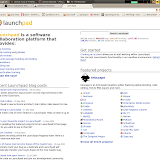
I want you to take a look at the screenshots very carefully especially the "project" pages. What's the one thing you notice about Github compared to the others (excluding BitBucket). What's the focus of the project?

It's all about the code

You'll see quite clearly that with all the sites except for BitBucket, the focus of the project is the code itself. Not only is the focus of the project the code but everything about the code is about the community. I can "watch" a developer or project. I can easily see from the first page how to download the codebase. However the biggest part of what makes Github a success is one button:

Fork

From the start of a project page, not only can I easily browse the code and am provided with the information I need to checkout the code but I'm invited with a single button to become a contributor to that project. Immediately, I'm a potential contributor to that project. If I change something and push the code back to my fork, I can push one button and send a message to the project maintainers asking them to merge the changes back in. As a project maintainer, I have an easy way to evaluate the impact of the change and communicate with the requester and other team members about said change. At the bottom of the pull request page, I'm provided the information on how to easily merge those changes into my main tree.

Designed for Developers

I've been on a bit of a tear lately about usability in developer-targeted products. The latest target of my ire has been Atlassian. Let me clarify that I think Atlassian makes some wonderful products. Confluence is one of the best wikis out there. JIRA is a great issue tracking system for Developers.

However, Atlassian has some "duds" in my opinion. The biggest thorn in my side these days is Bamboo. Bamboo is Atlassian's Continuous Integration server. Like most Atlassian products, its primary target is Java developers. Everything about Bamboo is designed around the Java development toolchain - Maven, Ant and the like. But I don't have a problem with that. What I have a problem with is the over-complication. I grabbed the latest beta of Bamboo at the recommendation of one of the Bamboo developers who heard my rant on Twitter one day. He asked for some feed back and I provided it in a very detailed email. I'm happy to say that the new interface for adding build plans in Bamboo is much simpler than previous versions. I can't do screenshots of our company Bamboo install but previous versions had a VERY complicated multitab build plan configuration.

One point I mentioned in my email is that Bamboo felt like it lacked a focus. Jira was very clearly about Issues. That was the "unit of work". Confluence was very clearly about being a wiki. That was its "unit of work". Bamboo didn't have a singular focus. It was a CI server but what was the unit of work? A build plan? Test results? Fisheye integration? It wasn't clear.

Compare that with Hudson which had a very clear focus. The strength in Hudson is that it performs tasks. Those tasks are typically centered around CI but they don't have to be. In Hudson I can define a job that does nothing more than list directories. I don't even need to back it with a VCS. Bamboo, sadly, in the beta version still hasn't gotten this part right. I can't define a build plan without having a repository somewhere. It still assumes that I want to define all my work inside of an ant script. Using the "shell" builder is still VERY limiting. 

You can see some sample comparison shots between the two here. I'll try to actually setup a repo that Bamboo can use and do a deeper comparison later. 

So what's the focus of Google Code, Launchpad...

Going back to code hosting and comparing Github to the others, I think it's clear that they lack a focus. They try to do too much. They "feel" like they were designed by project managers and targeted at them. Maybe it was a faulty assumption that to effectively manage a large project, you had have all of the extra stuff. I don't know. Launchpad and others DO some things better than Github. Issue tracking is one. Github issue tracking is a pretty weak area for them. However here's where Github understands its focus and strengths.

Where Github lacks, it makes up for in integration. Github doesn't TRY to be the project manager's tool. It doesn't try to be a good issue tracker. What it DOES do is say "I suck at this. My focus is on the code and making working with and contributing to the code dead simple. I'll add hooks for the other stuff"

And they do. Github has a boatload of service hooks for everything from issue tracking to project management to irc and IM. They even have a "generic" hook that will submit JSON to a url for you so you can write your own receiver.

About BitBucket, backend technology and focus

I haven't mentioned much about BitBucket. The main reason is that at this point, BitBucket is simple attempting to feature copy from Github except using Mercurial in the background. Sadly, this isn't enough I think. If my only reason for using BitBucket is the DVCS tool then I honestly might as well use Github. I'll get more engagement there. See this quote from Mark Philips from Basho about why the moved from BitBucket to Github:

Why? There are several reasons, the primary of which is that GitHub,

the application, lends itself to more collaboration when developing

open source software. Again, this was a decision made on the basis of

community development; technically-speaking we were satisfied with

what Bitbucket offered.

The issue wasn't the technology. Mercurial and Git are pretty much at feature parity (as is Bazaar). One thing mercurial doesn't do out of the box is cherry picking but it's supported with extra configuration. Mercurial has hg incoming which let's you see what people are working on. Git has staging. Mercurial has better Windows support than Git. It's really six in one, half dozen in the other.

However what BitBucket DOESN'T have is the community. You see, BitBucket was playing catchup to Github. Simply copying the social aspects of Github isn't enough. Github has too much momentum precisely because they had the focus right from the start - code is king.

As a developer, my key focus is my code. It's what says the most about me. As a developer who wants to attract other developers, the best way to do that is showing the code and making that contribution as easy as possible. Github gets that.

That's why people keep asking you to switch to Github.

Friday, October 22, 2010

Potato Candy - A family recipe

With Halloween right around the corner and Thanksgiving beyond that, it's getting about the time of year when I get to make Potato Candy. Yes, candy made from potatoes.

I don't know the real story behind it. Ever since I was a little pile of baby fat, it's something the kids in my family have eaten. My uncle only made it for Thanksgiving and I think Christmas get-togethers. I've tried to find a bit of history about it over the years but nothing ever concrete. My uncle's family is Irish so that's as stereotypical of a reason as any. What I did seem to track down is that it's pretty unique to the Southeast. We do things weird here, ya'll.

Not long after I married my wife (a Michigan native), her aunt was putting together a family cookbook. Now that I was part of the family I got to contribute a few things. I had my mom and step-mom provide a few entries but I reserved one for myself - Potato Candy. Since the "secret" is out and because freaking @jtimberman got me thinking about candy, I figured I'd add it here for all my interweb friends.

Ingredients

  • 1 Potato about the size of your fist. Seriously. Don't get it any bigger. If you've got big hands, find someone with normal sized hands and compare.
  • 1 jar of peanut butter. Creamy not Crunchy. The last thing you want to deal with when making this stuff is nuts. Trust me.
  • 2 bags of powdered sugar. Yes, you will probably use ALL of it.
  • Wax paper and plenty of counter top space

Peel and boil the potato as you would to make mashed potatoes. When it gets sufficiently soft, mash that bastard up. No lumps. Again, trust me. As smooth as you can get it.

Dump it into a large mixing bowl and reach for the strongest and sturdiest spoon/stirring instrument you can find. Start folding in the first bag of powdered sugar.

This is where it gets fun. As the powdered sugar gets mixed in, this thing is going to get thick and heavy very quickly. It's going to be VERY hard to mix. Did you trust me on the sturdy spoon part? You should have. Don't even think about putting this in an electric mixer. It will burn out the motor. I've literally broken 1/4 inch dowel wooden spoons in this stuff. Your arm is going to hurt. You're going to have to put your back into it.

When you physically can't mix it ANYMORE put it aside for a minute. Spread out a nice sized area on the counter with wax paper and cover it in powdered sugar. This crap is sticky and you're going to need to manipulate it. Once you've gotten the workspace ready, start spreading the "mash" on the wax paper. Usually about 1/4 to 1/2 inch thick is good. You'll probably screw it up the first time around. I did.

Open the jar of peanut butter and start spreading it on the mash. Peaks are okay but you really want to get a good layer on there.

Now, the hard part

Somehow you're going to need to roll from one end of this beast to the other. Like a jelly roll. It's really hard and don't feel too bad if it isn't pretty. The end result is still good. You'll probably want to cover your hands in powdered sugar.

Once you've got it rolled up, flatten it back out. Stick it in the fridge overnight. The next day, cut it into smallish 1.5inch slices and enjoy.

As I said earlier, I've tried to do some research each year. The best picture I can find outside of making some myself is this one.

You probably won't be able to eat more than one or two pieces. It's REALLY rich and really thick. If you give it to kids, do it early in the day so they have time to burn it off.

Enjoy ya'll!

Thursday, October 21, 2010

PyCon DevOps piggy back

So I had a random idea the other night and like any other random idea I immediately sent it to Twitter.

This of course brought feedback which is the whole point, right?

The idea was to have a Velocity style conference in the South East. We all know my love for Atlanta and my half-disdain/half-jealousy of the West coast. So I threw the idea out on twitter and immediately got my first reply from Joe Heck with a bit of reality thrown in:

@lusis nice idea. critical mass with either be easy or impossible to get. You might consider riffing on existing conferences ... PyCon2011

Awesome idea so I headed off to to read up on how PyCon does that kind of thing. I shot off an email to the pycon-organizers mailing list and got some really nice responses. I also got a private tweets from people on the list as well.

The end result is this. If I want to hitchhike on the back of PyCon for a devops-related conference, here are the requirements/suggestions:

  • Involve Python in some way
  • Will need to take advantage of the Open Spaces system

This essentially means unless I (or someone else) is giving a full blown talk on Python and DevOps, it will be an ad-hoc thing. We can't reserve the spaces until the day of the conference. I'm also not sure how big the spaces are. I think this is the same place LISA was held years ago so you might be able to snag a dividable room segment?

So what does everyone think? I'm considering giving a talk on the state of devops toolchains in Python (func, cobbler, fabric, kokki, overmind, whatever else) but I don't know that I'm ready for that yet after a single LUG presentation ;)

I know that Mitchell H. of Vagrant fame was considering heading into town for it. Vagrant isn't just for Rubyists ;)

I'm open to ideas. I'd love to just have the conference I sent the tweet about but when I really think about it, I don't think I can pull something like that off in this amount of time.

Many thanks to the pycon-organizers folks for the input - Doug Hellmann, Vern Ceder and Jesse Noller. Also to Dean Goodmanson for his feedback via Twitter.

Tuesday, October 12, 2010

Latest Vogeler update - MongoDB, protobufs, Riak and war!

I wanted to take a minute to post an update about Vogeler to those who are following the project. Let's get the easy stuff out of the way - it's not abandoned. Far from it.

There have been several reasons why I haven't made any commits lately, the least of which is both kids have been sick recently and I haven't been able to get a good solid block of time to work on it.

Technical Hurdles

Another reason is that I almost went down a rabbit hole with regards to swappable persistence. In the process of refactoring the persistence backend, I realized it should be fairly easy, using the model I put into place, to go ahead and implement MongoDB and Riak support. I started with MongoDB when I hit a wall. MongoDB does not allow dots in key names. When I ran into that issue, I realized that I made some dangerous assumptions based on the fact that I started with Couchdbkit as the interface to CouchDB:

I was using an ORM when I should have used a lower level driver. You see couchdbkit does some nice stuff like translating native Python datatypes to the appropriate datatypes. If I define a row as having DictProperty(), couchdbkit converts that into the commensurate CouchDB JSON datatypes. If I use ListProperty(), the same thing. This is really evidenced in Futon and makes using Futon as your interface to Vogeler very appealing. However this is VERY couchdb specific.

The pymongo driver, however, didn't like my strategy of dumping execution results that way. You can see the "gist" of what I'm talking about here:

;

I brought the issue up on the MongoDB mailing list here. I opened an issue for myself to braindump my thoughts. One of my biggest goals (data transparency) was starting to fall apart for me. I decided to shelve MongoDB for a moment and look at Riak. I wanted to make sure that I at least thought about how a generic model would work across multiple document stores. That's when I ran into the biggest cockblock:

protobuf

I'm almost firmly convinced that protobuf is a piece of trash. Google has some smart people but protobuf is something that quite obviously came out of the mind of someone who was sent off to "solve the RPC problem". There are quite a few issues I have with protobuf:

  • Despite being a "universal" format, it works well in exactly TWO languages - C and Java. Everything else is an afterthought. Don't get me started on Python support. The one guy at Google who supports protobuf on Python can't make it work on anything but Python 2.5 because that's all Google uses. He's unwilling to cut a new PyPi package just to fix all the 2.5 assumptions because he doesn't want to bump the version number. You can't even install it on anything higher than 2.5 without hacking setup.py.
  • You have to precompile your protos before use. I understand what Google is trying to accomplish but seriously? So I have to build the protobuf compiler to compile protos to ship with my code. There's a reason why people like FFI folks.

There are alternatives like Apache Avro that have promise but they also have their own issues. However, Basho has committed to using protobuf which does make sense. Write your own serialization framework or use an existing one? Easy answer when Google wrote one for you.

So I started to noodle out what route I wanted to take when something else came out of left field.

Sgt first Class Lance Vogeler

I have a search setup in Tweetdeck on my Droid for Vogeler. It was nice to stay on top of people mentioning the project. The name for the project came out of me pretty much immersing myself in the latest S.M. Stirling Emberverse books. One of the characters was named Ingolf Vogeler. I really enjoyed the books and liked the name so I picked it. I'm also considering using Ritva for another project.

So one day my phone starts going nuts with Vogeler alerts. I was already getting the occasional history tweet about the real Ingolf Vogeler but it turns out a soldier from Georgia, of all places, was KIA in Afghanistan. He did 8 tours in Afghanistan and 4 tours in Iraq. Politics aside (I'm personally entirely against these campaigns), I didn't want to "pollute" the twitter stream. Regardless of what I think of the current military climate in my country, I have the utmost respect for most of the members in our armed forces.

However what struck me most is that SFC Vogeler left behind a wife. A wife carrying his unborn child. That pretty much did me in. As a father myself, I was pretty torn up thinking about this happening to my wife. Yes, it was a known risk but that doesn't make it any less sad. I decided, in addition to making a donation of my own to his family and holding off on Vogeler till it wasn't alerting on Twitter so much that I would think hard about what my software means.

Steve Jobs asked a guy who emailed him this question "What have you created lately?" Someone else recently said that entrepreneurs are busy creating the next social media app that means fuckall when they could be affecting change with the software they write. That got me thinking. Could I help affect this family somehow with my project that happened to share a name with them? The best I could come up with is this:

If you use Vogeler, are interested in it or just feel like a random act of kindness, please make a small donation to the Vogeler family. My wife and I agreed that should I ever make ANY money off of the project in any identifiable form that I would donate what I could to the family. Vogeler is just a small project. I have no grand aspirations of getting integrated into some mainstream project. I'm just trying to scratch an itch - a niche itch at that. One reason I'm so gung-ho about DevOps is that, as a family man, I don't WANT to be dealing with stupid shit taking time away from my family. I've done it and I'm done with it. If my phone goes off, it's not going to be from some stupid mistake that I made editing a config file or lack of metrics causing an "oh shit we're out of space" moment. I'm past that in my career and I'm past having to work places where that's the norm rather than the exception. My family is first and foremost and anything I can do to keep it that way, I'm going to do it.

So I'm taking the Vim approach to Vogeler. I'm not going to ask anyone to go against his conscience. If you feel like a small donation to this family implies consent to the stupidity of my government then I fully understand. But if you think that open source software and the broader open source community can make a difference in more than just writing software, throw a small donation their way.

I'm going to be starting back up on Vogeler now. I've decided that for now, I'm going to attempt to keep things as generic as possible but continue to code against CouchDB. I'll keep revisiting MongoDB and Riak support but the primary target is CouchDB. If any Basho folks are reading this, if you can remove the hard dep in setup.py on protobuf, that would be awesome. You can't even install from PyPi with it in there anyway. If the MongoDB folks take a gander at this, can you do something about the dots in key names? Thanks!